
10 SA1 2018 Mistakes


Let's learn from the mistakes of other students.
Be sure to get it correct in prelims! 

Question 1 
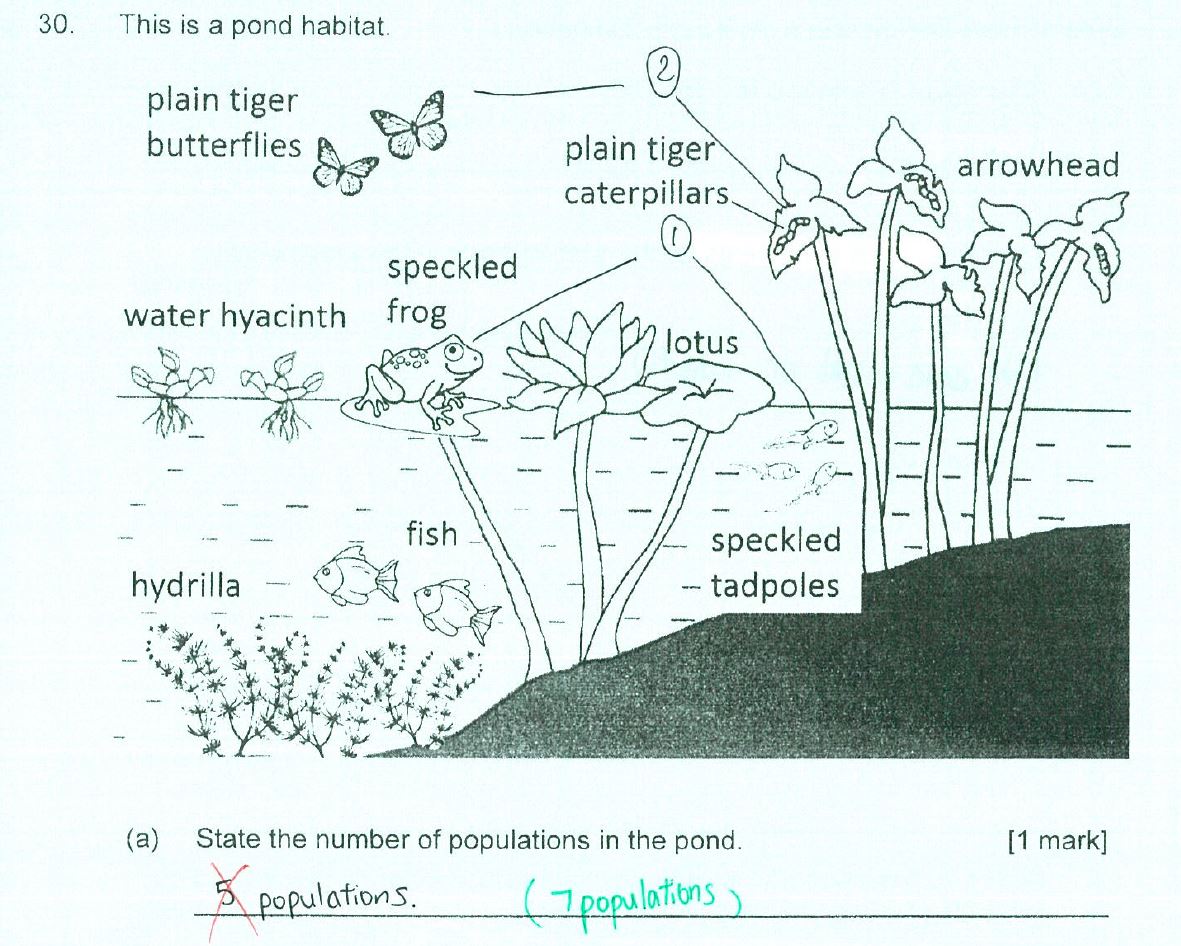
Topic: Living Together
Common Mistake: Not counting young and adult as 1 population

Answer: 7 population 

1) Plain tiger butterflies + caterpillars
2) Speckled frog + tadpoles 
3) Arrowhead
4) Hydrilla 
5) Water Hyacinth 
6) Fish 
7) Lotus 

Question 2


Topic: Adaptations 
Mistake: Did not use the information from the question 
Answer: Bumps on flippers (found in last sentence of paragraph)

Question 3

Topic: Cells 
Question chosen because it's not common that the questions are tested in this way. 
Good learning point. 

Question 4

Topic: Heat
Common mistake: Confused students / no working / working in the brain thus leading to mistakes.  
Answer: 2 

Question 5

Topic: Heat
Common misconception: Student think that when metal gain heat and expand, the mass increase
Answer: 3


Question 6

Topic: Energy in food 
Mistake: Wrong usage of words. 
Answer: use "lower rate of photosynthesis" instead of "cannot photosynthesize"

Question 7

Topic: Plant Transport system
Common mistake: Most student chose 1 because the concept is that water carrying tubes are still present, so the leaves can still photosynthesise and make food.
Answer: After 14 days, the roots will die because it cannot receive food from the leaves, so water cannot be transport to the leaves and it will wilt. 

Question 8

Topic: Water cycle
Mistake: Confused between the terms 'steam' and 'water vapour'

Answer: 4
During change of state, 2 states are present!

Question 9

Topic: Water cycle
Try to apply the strategy from question 8 that I have shared earlier :)
Answer: 4
(only gaseous state present) 

Question 10


Topic: Water cycle
Mistake: Exposed surface area OF WATER
Missing keyword

If you would like to help your PSLE child who needs a boost in keyword answering, you could check out my previous posts: 

Comments

Post a Comment

Popular posts from this blog

Answers to PSLE Questions

Why do I write suggested solutions to Red Swastika 2018 SA1 Paper? - My students found it useful and requested for more!  - The parents who used it to help their child have found it useful!  That's why despite using 4 hours just to write ONE SET of the suggested solutions (Section B only) and doing the miscellaneous admin such as scanning, downloading documents, writing email to send out to our ISUN warriors, I do it.  Hope that all these will contribute to their learning :)  From the paper, there are quite a couple of questions from the PSLE Booklet: You can download the Red Swastika 2018 Paper here!  Red Swastika 2018 Q 30 Reproduction of Plants PSLE 2018 Q15 TEST IT OUT!  PSLE 2018 Q15 ANSWER  Red Swastika 2018 Q33 Adaptations PSLE 2013/ Specimen Paper Adaptions TEST IT OUT!  PSLE 2013/ Specimen Paper Adaptions ANSWERS Refer to other posts to learn more! Water cycle: htt...

Respiration and Photosynthesis

Respiration and Photosynthesis With air quality going downhill, there may be chances that we need to carry plants around as our oxygen tank.  The working mechanism is based on 2 simple concepts of Primary 5 Science, Respiration and Photosynthesis.  As seen from the picture, the man is wearing a mask connected to the plant. As the man respires, it gives out carbon dioxide.  The carbon dioxide, together with water and light, the green plant with cholorphyll photosynthesises and produces oxygen for the man to respire and survive.   A summary of the both respiration and photosynthesis processes are below: Respiration Respiration is the breaking down of digested food with oxygen to produce energy. The equation of Respiration Sugar (from digested food) +  Oxygen (from inhaled air)   รจ  ENERGY (for body to use) +  Carbon Dioxide (to exhaled air) + Water Vapour (to exhaled air)  *NOTE* All living things respire includ...

Amazing Animals' Adaptations 3: Raptor of the Sky

From the oceans, let's rocket to the sky to understand about the powerful eagle, king predator of the sky. As the video does not mentioned anything much, below is a summary of the adaptations of the eagle. Eagle's Adaptations Eagles and other birds are commonly tested in Primary Science Examinations, especially with regards to their body shape, feet and beaks Primary 6 Science Application Questions: Adaptation QUESTION 1 Two birds, Bird A and Bird B, were kept separately in two cages as shown below. 300g of seeds and 50 ml of nectar were placed in each cage at the start of the experiment. After two days, the amount of seeds and nectar were recorded in the table shown below. Mass of seeds at the start of the experiment (g) Mass of seeds at the end of the experiment (g) Cage with Bird A 300 300 Cage with Bird B 300 100            Volume of nectar at the start of the experiment(ml) Volume of the nectar at ...